|
 |
Intuitive Communication with Animals: Reclaiming Our Kinship with All Life
By Analise Cross, Ph.D.
Published in Arizona Choices in 2007
All Rights Reserved © 2018 by Analise Cross
Introduction
More than fifty years after the publication of the pioneering book Kinship with All Life by J. Allen Boone, a hardboiled journalist who came to see the light through his experiences with a remarkable dog, there is still widespread skepticism regarding intuitive communication with animals and a tendency for animal communicators to keep a low profile.
And of those who do acknowledge telepathy with animals, many would have us believe that it is restricted to a select few having an inborn gift. In an era in which we are challenging patriarchy and taking our power back on a widespread scale, this article seeks to demonstrate that all humans have an innate capacity for telepathy with animals and other life forms that has been repressed through flawed conditioning and that can be reawakened readily.
As J. Allen Boone discovered with the help of Strongheart, we need to reclaim our ancient birthright of a shared language with all living things that was "so simple and natural a part of everyday living as not to need explaining any more than breathing"…
Methodology
(To Be Used in the Presence of a More or Less Stationary Animal)
Step One: Centering and Grounding
Close your eyes and focus on several slow, deep breaths. Pretend you are a tree, with roots extending from the bottom of your feet deep into Mother Earth: at the surface, large, gnarly roots, then smaller rootlets, and at the deepest level, tiny hair-like structures.
Imagine these structures coming upon a pool of shimmering gold, which you want to bring up into the tree's body. Slowly bring the gold up the roots from smallest to largest, and when it reaches your feet, picture it filling them from toe to heel.
Continue filling the rest of your body: ankles, calves, knees, thighs, torso, arms, wrists, hands, neck and head. Now picture the luminous gold spilling out your crown so that you are both filled with it and surrounded with it.
Step Two: Asking for Help
In line with wise caveats about not relying on ego or intellect in intuitive efforts, ask a higher source of power for assistance: angels, totem animals, your Higher Self, the nondominant side of your mind — whatever feels right for you.
Step Three: Setting Your Intention
Again, follow your heart. This step can be as simple as saying "I state my intention to speak with..." or as complex as you want, e.g., incorporating your wish to be an instrument of divine will or to serve the highest good.
Step Four: Connecting
Say the animal's name, or if you don't know his or her name, just say "this animal," three times, very emphatically, either silently or aloud. Even if the animal is asleep or distracted in some other way, this will create the connection for opening a dialogue.
Step Five: The Dialogue
Begin by explaining that you would like to ask a few simple and nonintrusive yes-no questions to help you develop your confidence in animal communication.
Adapt your questions to the animal: if your nearby animal is a horse, you might ask "do you like carrots better than apples?" Trust the first answer, yes or no, that comes into your mind after asking each question.
Next ask for an elaboration on one of the yes-no questions, e.g., "aside from treats like carrots, what is your favorite thing in the world?" Again, trust whatever enters your mind. It might take verbal form, such as a word, phrase or sentence, perhaps relating to running. It might instead take the form of a mental image of a running horse. It might be a feeling or an energy suggesting running or speed. Or it might just be an immediate knowing: this horse loves to run!
If the first response to enter your mind makes no sense to you, do not despair: trust that it means something to the animal, and simply isn't (yet!) clear to you. The point is, you got something rather than nothing. You need to trust that this something was in response to your question, and that you did not make it up.
The latter worry, that you fabricated the answer, is almost universal to newcomers. There are ways to mitigate this worry, such as asking yourself if what you received is something you would be apt to make up. Sometimes it just isn't. Even if it is, it undoubtedly came from the animal. You will come to trust this with ongoing practice, including working with others and comparing answers with each other, or checking your answers with the animal's human. (Note that in a workshop setting you can use both these methods of validation.)
Step Six: Thanking the Animal
Thank the animal for talking with you and compliment him or her on any special quality you noticed, such as forthrightness, patience, or honesty.
Some Common Applications
Information Exchange
Many people are already at least semi-aware of animals receiving human information even when nothing is said aloud. The incident that convinced J. Allen Boone was Strongheart's fetching his shoes right after a thought about interrupting his writing to take the dog for a walk. An experiment in Britain designed by biologist Rupert Sheldrake, Ph.D., has received widespread attention, most recently in the publication of an article by Sheldrake by The Times on September 7, 2006…
Exercise: Testing Animal Mind-Reading
Try using the methodology given above to ask an animal to show you in some way that he or she can read your mind. You might telepathically request that your dog come over to you (using controlled conditions such as not looking right at him when you ask), or that he give you his paw (using your usual command silently).
Exercise: Receiving Information from Animals
Try also being the recipient of the animal's information, in areas such as the following:
- Name preferences: Discovering if an animal likes his or her name
- Care assessment: Determining if an animal's needs are being met
- Background information: Learning about a rescued animal's early life
- End-of-life decisions: Addressing issues of death and dying (e.g., determining if an extremely ill animal wants euthanasia, or asking a recently departed animal what it was like to transition and where he or she is now)
- Therapeutic relationships: Animal-assisted therapy (e.g., discovering if and how one or more of your animals plays a therapeutic role in your life, asking a therapy animal how he or she approaches therapy, or telepathically cooperating with an animal in helping others, as in therapeutic equitation)
Conclusion
In Kinship with All Life, Boone recalls ancient times when humans and other life forms had a common language for expressing "their thoughts and feelings freely on matters of mutual interest," when they worked together for "the common good, the common happiness, and the common fun." What he wrote over half a century ago has crucial relevance today:
As we live through these kaleidoscopic days when confusion, distrust, conflict and misery are so common everywhere, it is revealing to note that more and more people are finding reassurance and peace of mind in companionship beyond the boundaries of humanity....Values...essential to life and well-being...[are] flickering very low in the human species and threatening to go out entirely....Practically every animal still has these assets and is eager to share them, given opportunity and encouragement.
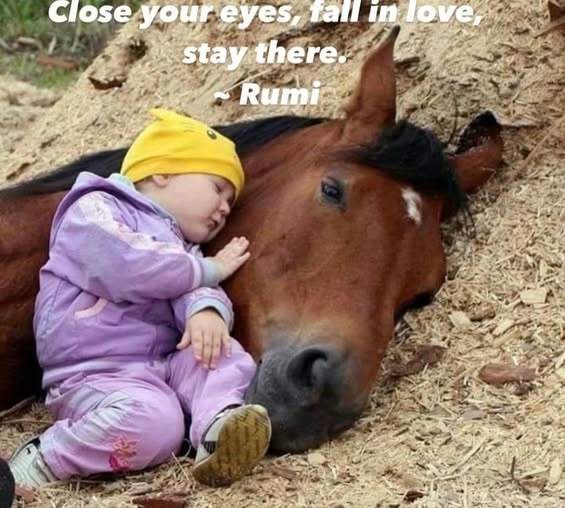
Among the therapy horses for children, Tristan was the oldest and safest for very young children. He blessed kids with extraordinary love energy, and they flocked to him after the trauma of 9/11.
|
|
|
 |
|